
What Is Intelligence
The Goal Was Never to Amplify The Artificial
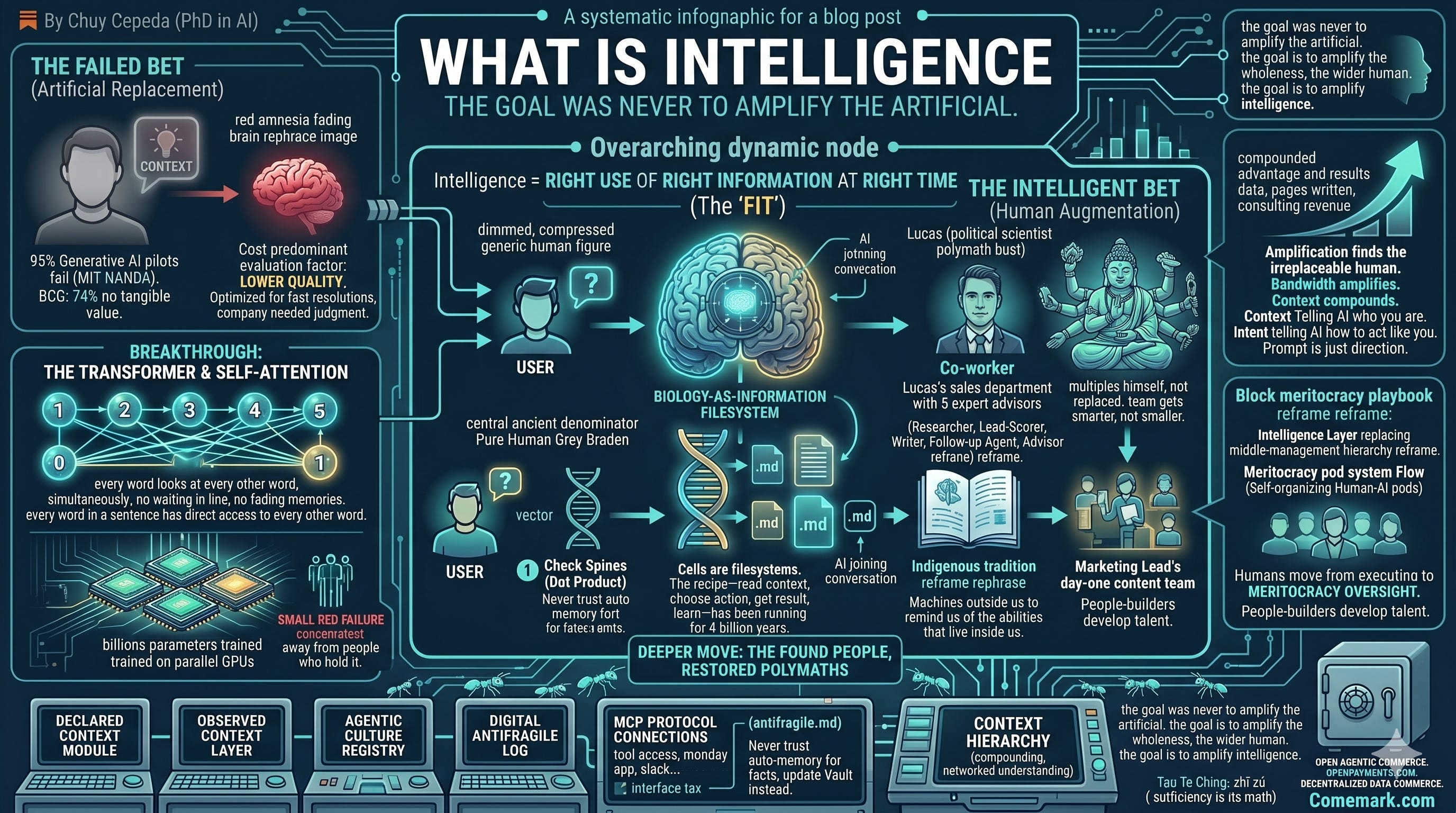
Two months ago I named my Substack “The Amplifier.”
I never said the word out loud.
For fifteen posts, I described amplification in every direction — fortresses, operating systems, resurrected philosophers, kidnapped geniuses, files that change everything, agents that turn politologists into sales departments, context hierarchy — without ever claiming the frame.
While I’ve been sharing my practice, the AI industry seems to be busy renaming: workforce as a service, zero-people companies, the end of SaaS, 30+ tips to fire your team faster, yet another thing no one is talking about...
This past week I caught it: the entire AI industry has been amplifying the wrong thing.
This post is the one I should have written first.
What intelligence actually is
Start with what I should have led with.
Intelligence — as I understand it — is the right use of the right information at the right time.
Intelligence is not raw IQ. Not knowledge stockpile. Not access to tools. Intelligence is the fit between what a person knows and what they do, in the moment that calls for it.
I’ve said this before, in past posts: today’s competitive advantage is no longer what you know — it’s the speed at which you can create what you can imagine.
Once you put it that way, you start noticing where AI sales decks stop paying attention. The model isn’t the scarce resource anymore. Neither is the information. What’s scarce is the fit — and fit is what humans, holding context over time, actually produce. AI models amplify. They don’t substitute.
Almost everyone selling or talking about AI right now is aiming at substitution, not amplification.
The four-billion-year conversation
Here’s the thing that locked it for me.
I’m reading Gregg Braden’s Pure Human right now. The reframe is small. Stop thinking of cells as “sticky, gooey stuff” doing chemistry. Start thinking of them as filesystems. Fifty trillion of them per human body, each carrying 23 chromosome pairs — the books — totalling about 20,000 genes — the chapters and words. Once you make the shift from biology-as-chemistry to biology-as-information, the question “is there a message in here?” stops being a category error and starts being the obvious thing to ask.
If cells are filesystems, intelligence isn’t something a body produces. It’s something a body runs. The recipe — read context, choose action, get a result, learn — has been running for four billion years. When AI showed up, it didn’t invent intelligence. It joined a four-billion-year-old conversation. And it brought an invitation to expand our filesystems.
What we’re calling artificial intelligence is the same intelligence on a new substrate. Same recipe. New medium. The word artificial was always misleading; it suggested something separate, alien, eventually superior. It isn’t. It’s an extension of a pattern that’s been running through cells, then bodies, then language, then writing, then the printing press, then the calculator, then the search engine, then the smartphone — and now agents.
Each one of those moments was someone worrying that the new tool would replace the old human. Each time, the thinking and the math went up, not down. They migrated to a higher altitude. They amplified.
We just need the right bet.
The bet on the artificial
Here’s the discourse I should have pushed back on two months ago.
The replacement frame is everywhere because it’s selling. Foundation Capital writes a memo sizing the AI market at $4.6 trillion — global services labor reframed as software TAM. Sequoia describes “Service-as-Software” as the inevitable next category. Sierra hits $100M ARR in twenty-one months selling autonomous customer-service agents at a per-resolution rate. Decagon: $35M ARR pushing it to a $4.5B valuation by early 2026. Cognition’s Devin ships pay-as-you-go Agent Compute Units — about $2.25 for fifteen minutes of an AI software engineer’s time, reportedly raising at $25B as I write this.
The handle is convenient. AI workforce. Two words a board has heard before, mapping onto a mental model that already exists — hire, manage, pay, replace. The buyer doesn’t need to be educated; they only need to sign.
But notice what the framing assumes. The buyer is not the operator. The buyer is the executive removing the operator. The conversation lives at the boardroom level — overwhelming, confusing, calibrated to make executives feel dumb if they aren’t already firing everyone. Targeted at the people who buy the speed, fear the disruption, and sign the checks.
Here’s the catch — when you actually read the data underneath, the frame is already failing at the layer it claims to win.
Commonwealth Bank of Australia cut 45 customer-service roles in July 2025, replacing them with an AI voice bot that was supposed to reduce call volumes by 2,000 per week. Call volumes went up. Wait times exploded. Managers had to start taking calls themselves. Within weeks, CBA publicly admitted the “error” and rehired the workers.
IBM replaced ~200 HR roles with an AI agent (AskHR) that automated 94% of routine tasks — and then quietly grew its workforce elsewhere, hiring programmers, salespeople, and strategists for the work AI couldn’t touch: judgment, ethics, the conversations that actually shape culture.
Klarna‘s AI customer-service agent saved the company $60 million — then the CEO went on Bloomberg to explain why they were hiring humans back. “Cost was unfortunately a too predominant evaluation factor. What you end up having is lower quality.” The AI optimized for fast resolutions. The company needed judgment, not just speed.
Three different companies. Three different industries. Same pattern: the AI was technically working — it was just optimizing for the wrong thing.
This is becoming the norm. 95% of generative AI pilots fail to deliver measurable business impact (MIT NANDA). 42% of companies abandoned most of their AI initiatives in 2025 — more than double the prior year (S&P Global). 74% of companies globally still haven’t shown tangible value from AI (BCG). And 55% of employers who laid off workers for AI now regret it (Forrester) — two in three are already rehiring; one in three spent more on rehiring than they ever saved from firing.
These aren’t numbers about bad technology. The models are extraordinarily capable. These are numbers about organizations that bought a frame about AI before they understood what AI actually does — they stripped context away from the people who hold it. And we just said: context-fit is what intelligence actually is.
Their bet was on the artificial.
The bet on the augmentation
There’s another bet.
Call it co-worker as a service. The AI doesn’t replace your team — it joins it. Every human plus their AI team becomes the new unit. Bandwidth amplifies. Context compounds. The team gets smarter, not smaller.
This isn’t a soft-pedal of the technology. It’s a sharper read of what the technology actually does best. AI does not have judgment. It does not hold relationships. It does not own outcomes. It does not feel the weight of a deal that affects fifty livelihoods. What it has — at superhuman scale — is the ability to route the right information to the right person at the right time.
I’ve heard many senior executives saying “I need bandwidth to set up my AI”. I tell them, you need your AI to set up your bandwidth. Simple reframing, different bet.
The intelligent era changes the moment you stop asking “how do I replace this role?” and start asking “how do I amplify this person?” You stop building agents that masquerade as employees and start building co-workers that augment them. You stop measuring tasks completed by AI and start measuring decisions improved by AI. You stop firing the people who hold the context and start equipping them with a chief of staff who never sleeps. You aim for polymaths and true human essence. You get bandwidth.
I have working examples at three scales.
Three weeks ago in The Augmented Leader I wrote about Lucas — my cofounder, a political scientist, not a programmer, who built a sales department in his second week of using our system. He didn’t replace anyone. He equipped himself with five specialized co-workers — a researcher, a lead-scorer, a writer, a follow-up agent, and an expert advisor coaching the others.
“Digital life will be like this. If you manage your life in MDs, it doesn’t matter if it’s Claude or Gemini or whoever. You’re completely portable.” he said.
Then a team installed it.
Our marketing lead got the system. By evening — day one — she had produced a newsletter calendar, a content strategy, social posts for the week in two languages, a UX testing strategy, and a growth plan through June. Her review: “It feels like having a full content team running.” Our CTO scaffolded a Tauri desktop app for the AI-OS interface overnight — fifty-four files, authentication wired in, ready for review by morning. Our engineering lead, in his first week, shipped three pull requests that improved the operating system itself, then audited 142 adversarial attack attempts against our public AI assistant — every vector traced, every fix in, zero leaks.
Nobody assigned any of this. The system made the gaps visible; the humans had the judgment to close them.
Sales, marketing, technology — none of them were hired for half of what they shipped that week. The system didn’t make them faster at their job — it gave them back the parts of themselves their job had narrowed away. That’s the actual move.
AI kills specialization-as-economic-armor.
What’s left isn’t a smaller team. It’s a wider human.
Then a $50 billion company tried it.
Last March, Jack Dorsey published the playbook for what Block — Square, Cash App, Afterpay — is doing internally: dismantling its middle-management hierarchy and replacing it with what they call an intelligence layer. Three human roles remain:
Specialists who go deep,
Problem-owners with authority to pull resources, and
People-builders who develop talent.
Everything else — the routing, the prioritization, the coordination overhead — gets absorbed by the layer.
You might be thinking: but Dorsey just laid off 40% of Block’s staff. Fair call. Block IS doing layoffs (and, like CBA, IBM, and Klarna, quietly rehiring). So is everyone else who buys the AI workforce frame, even when they swear they’re not. The middle-management coordination layer is being absorbed. The humans who remain are the ones doing work AI cannot do — judgment, relationships, depth.
Some roles are being absorbed.
The ones that aren’t? They skyrocket.
Amplification finds the irreplaceable human.
Some humans aren’t ready for that finding.
Some are desperate for it.
People-builders aren’t a footnote. It’s the real job. The work isn’t deciding who AI can replace. The work is discerning who’s ready to be amplified, and building the rest into the kind of human who is.
That’s a different muscle than the one the AI workforce pitch is training for — and a different decade ahead.
That’s intelligence.
The intelligent bet
One bet is failing in the data. Another is promisingly working in production. Yet both sit on a common ancient denominator.
How would you define the capacity for a human – holding the right context, in the right moment – to act with wisdom that exceeds what their isolated body and brain alone could create?
Braden calls this “divinity,” the act of breaking through the limits we’ve been conditioned to accept as immutable. In his book, Braden shares a story from a native elder whose ancestors had passed forward:
“The people of the Earth began to forget who they were. They began to forget the power they held within themselves. They forgot how to imagine, how to create, how to heal, and how to dream. They forgot their relationship with Mother Earth herself. They became lost, frightened, and lonely. They longed for the connection that they knew was possible, yet they couldn’t find it in their lives.
In their loneliness, they began to build machines outside of themselves that reflected the powers they dreamed of. They built machines to enhance their senses of sight. They built devices to amplify the sounds that they could no longer hear and other machines that could send healing into their bodies just the way their bodies used to create healing from within themselves.”
The elders say the story continues today. That we are the descendants of the lost people. That we’re still lost. That we became narrowed versions of our truest selves. That we build the complex world of technology outside of us to remind ourselves that they mimic the abilities that already live inside of us.
“We continue to clutter our world and lives with gadgets and devices until the day that we wake up from our dream of longing.”
I think they’re right. We are those descendants. And we’re also the first generation with a chance to be something else. Not amplified versions of our compressed selves — that’s just lostness with louder volume. The deeper move: the found people. Restored to the range we forgot we had.
Polymaths over the specialists.
For most of human history, the painter was also an anatomist, the architect was a poet, the merchant was a diplomat. We didn’t fragment ourselves until economic survival required it — until industrialization made the specialist cheaper than the polymath.
AI is the first technology in two centuries that stops rewarding the narrowing — extending the creative range we’re finally remembering.
The challenge is where we point the incentives.
The language of amplification pointed at the wrong layer — fire the workforce, zero-people company, you need no one — the one that shows AI as a different kind of intelligence rather than as the latest medium through which the same intelligence we’ve always had finds its truest range. That misreading is what produces the replacement discourse.
The goal was never to amplify the artificial.
The goal has always been to amplify intelligence.
The wholeness, the wider human.
Lucas said: “Esto potencia al humano que no reemplaza.”
— this amplifies the human it doesn’t replace.
Read it with the emphasis where it belongs: the human that it doesn’t replace. The wholeness-human. The one that is about to skyrocket. The found one.
Intelligence has always been yours.
Your bet is to remember.
If this resonated, share it with a leader who’s deciding what to amplify next. Then ask yourself the same question — about your business, your team, and the part of your work that nobody else can do for you.
Chuy Cepeda is co-founder of Sovra (The Identity Stack) and author of The Amplifier, where he writes about humans, AI co-workers, and the intelligence that compounds when you put them together correctly.