
The File That Changes Everything
Stop writing better prompts. Start wiring better context.
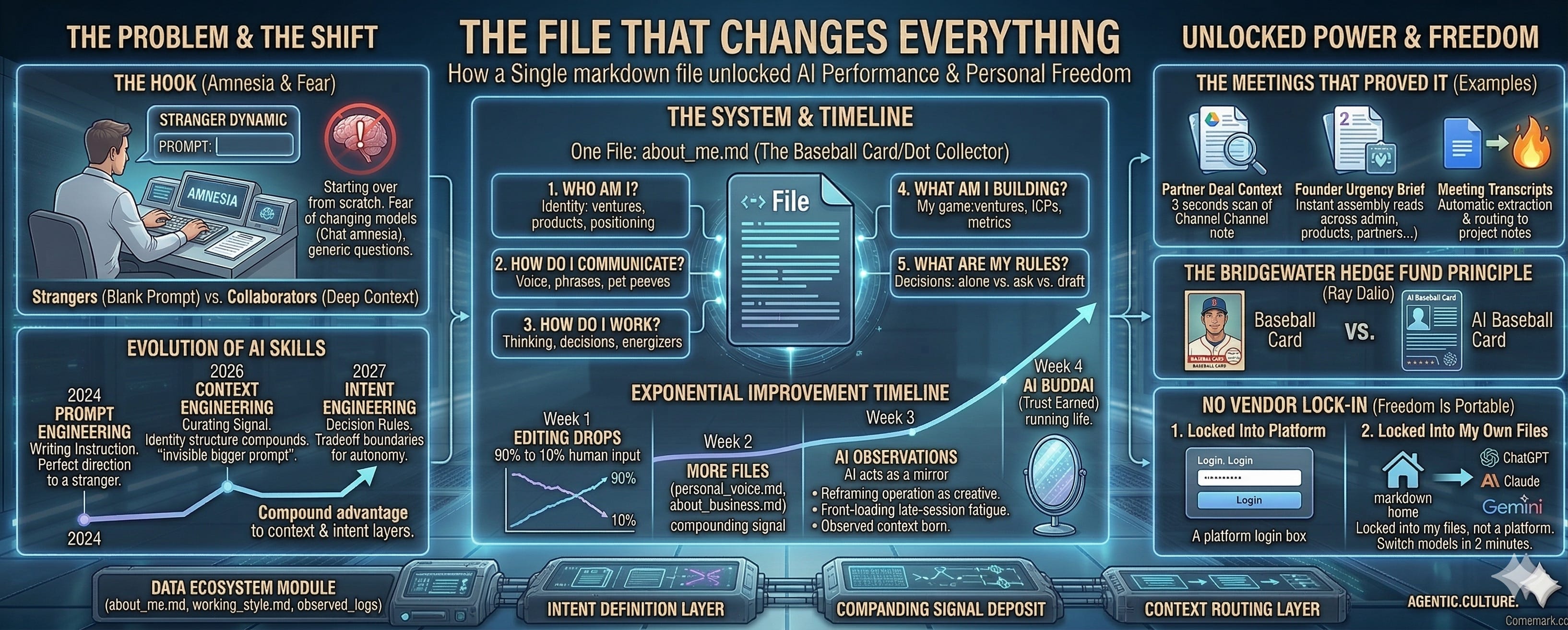
I wrote one file, gave it to Claude, and two things happened.
The AI got dramatically better. And... I became free.
This is the story of both.
The Hook
You’ve been using the same AI chat for weeks. Maybe months. It knows your company. It knows your tone. It remembers that project you described three Tuesdays ago. It’s finally useful.
Then a better model drops. A friend shows you something faster, smarter. And you think about switching. It happened to most of us the early adopter when leaving chatGPT.
Something stopped us. Not loyalty. Fear. The quiet fear of starting over (or even making the same mistakes again) — re-explaining your company, your voice, your projects, all of it, from scratch. Momentum loss. Everything the AI knew about us lived inside that chat thread, on that platform, behind that login.
The AI isn’t keeping you because it’s the best. It’s keeping you because leaving means amnesia. That’s the hook.
And even if you stay, the chat thread has limits. It doesn’t connect your business context to your project notes. It doesn’t route a question like “what’s urgent for my cofounders?” across thirty threads to give you one answer. It doesn’t observe your patterns over time and tell you what you’ve been avoiding.
It remembers what you said. It doesn’t know who you are.
One File
A few months ago, I opened a blank markdown file. I named it about_me.md. I answered five questions:
Who am I? — Name, role, what I’m building, what I care about.
How do I communicate? — My tone, my audience, my phrases, my pet peeves.
How do I work? — How I think, how I decide, what slows me down, what energizes me.
What am I building? — My ventures, my products, my team, my positioning.
What are my rules? — When AI can act alone, when it should draft, when it must stop and ask.
I asked ChatGPT to help me answer them. It was the AI tool that knew me better than any other out there — we all started there, right? It took about ten minutes to write, refine, and fill. Not because the questions were hard, but because I’d never been that precise about the answers. Writing about_me.md wasn’t configuring a tool. It was an exercise in clarity about my own identity.
Then I told Claude: read this file at the start of every session.
The difference was immediate. Before the file, Claude asked generic questions. “What’s your target audience?” “What tone do you prefer?” After the file, the questions disappeared. It already knew. Instead of asking me to set up the chessboard, it started playing chess.
Claude started writing first drafts that sounded like me. Not perfect — but recognizably mine.
One file. Ten minutes of writing it. The AI went from generic assistant to collaborator that knows my game.
What Happened Next
Week 1 — the editing dropped.
Every draft Claude produced started closer to final. I went from editing 90% of the output to 10%.
Week 2 — I added more about me.
personal_voice.md — how I sound by audience: investors, governments, clients, team. working_style.md — how I make decisions, how I prefer to receive information. about_business.md — what my company does, our positioning, our ICPs, our metrics.
Each file made every future session sharper. Not linear. Exponential.
Week 3 — the AI started observing things about me.
This is the part that changed my relationship with AI permanently.
Claude began writing observations. Not because I asked — because the system was designed to learn. After a few sessions, it wrote:
“When faced with operational tasks, tends to reframe them as creative work before executing. Binary ship targets prevent drift; abstract goals don’t.”
I stopped. It was true. I’d never articulated it. The AI saw a pattern in my behavior before I did. It changed the redaction of my to-do’s and I didn’t understand why until I looked into the observed logs. It manipulated me to my benefit.
Then this one:
“Important recurring steps placed at the end of long sessions get silently dropped. Any step that requires a prompt late in a session will eventually be swallowed by fatigue.”
Uncomfortably accurate. I was losing important work to end-of-session fatigue. The AI noticed, documented it, and now every future session accounts for it — front-loading critical tasks, never burying important steps at the end.
Original files became the declared context, where I tell the AI who I am.
And then observed context was born, where the AI tells me who I’m becoming.
Week 4 — the AI knows my projects.
This is where the collaborator knowing my game started to earn my trust.
I started pouring projects notes. Deals, admin work, backlog, everything. We started not working together but running my life together. And in every single front of my life it proved I can trust my AI. I started calling it my AI buddy: my Buddai.
The Meetings That Proved It
Fast forward to this morning. Three examples of how dramatically everything improved.
Example 1.
I’m in a sales meeting. Someone mentions a partner deal. I need the details — not the CRM summary, the actual context: what was proposed, what the terms look like, what’s blocked.
I type one sentence: “What did X partner propose to Y customer?”
Three seconds. The AI scans notes, finds the one tracking this partner channel, pulls the section, and gives me: two stages — $X first deal at Y% margin, $Z implementation as stage two.
I didn’t search. I didn’t open a folder. I didn’t remember which note it was in. The system knew.
Example 2.
“What’s urgent for founders this week?” Founders isn’t one note. It touches the admin board, the products, the website, the partner portal, the AI platform, financials, legal, and many more. The AI reads across all of them and gives me a briefing in two seconds that would take a human chief of staff a couple of hours to assemble.
That’s context compounding. My notes became a living system where every file connects to every other file, and the AI is the routing layer that finds the answer instantly. I felt i was “super prompting” because a single question had many related notes as context, turning my prompt query into “an invisible bigger prompt”.
Example 3.
And here’s the part that surprised me most: changing what meeting notes are for.
Everyone I know has an annoying AI notetaker in their video calls now. Gemini, Otter, Fireflies, Read — the transcript gets generated, emailed to you as a Google Doc, and then... nothing. It sits in your Drive. You never open it. Neither does anyone else. Millions of meeting transcripts, piling up in folders, unread and unactionable.
Today I had a three-hour founders meeting. Four people, eight major decisions, five projects affected. The transcript landed as a Google Doc. Before the context layer, that transcript would have been another long file I’d never read — stored just in case.
But now, the AI read it, extracted the decisions, and routed them — automatically — to the five project notes they belonged to. The pricing strategy went to the partner project. The product decision went to the AI-OS project. The legal strategy went to the admin project. The wallet feedback went to the wallet project. Each project note now has a dated entry with the decision, the context, and the follow-up tasks. And a daily note got updated with the summary, pointing to the whole transcript just in case.
Tomorrow morning, when I run my daily plan, those decisions will already be in the system. The tasks will surface. The priorities will reflect what was actually decided, not what I remember being decided.
Meeting transcripts stop being files you never read. They become intelligence fuel. They are gold now.
The fun part of these three examples is that it almost feels obvious — right data at the right time will always put us in a better position to act. And I like a story far from AI where this enlightens the power of context.
The Hedge Fund That Solved First
Someone figured this out in the early 2010s — without AI.
Ray Dalio’s Bridgewater Associates, $150 billion under management, had a familiar problem: people walked into meetings with no context about each other. A detail-oriented analyst would get assigned a big-picture task. A quiet thinker would get steamrolled by the loudest voice. Same meeting, same people, wildly different outcomes.
His fix: Baseball Cards. Every employee gets a living profile — scored on dozens of dimensions like inquisitiveness, assertiveness, detail orientation, conflict resolution. Updated constantly from reviews and a real-time tool called the Dot Collector.
Before a meeting, you pull up the cards. You know Maria is a 9 on detail but a 3 on big-picture framing. You know Carlos is assertive but weak on follow-through. Decisions got better — not because the people changed, but because context was loaded before the conversation started.
That was years ago. For humans, about humans. Simple, clever.
Now think about AI. Every session, you walk into a meeting with the most capable collaborator you’ve ever had — and neither of you has a Baseball Card. No profile. No context. Just a blank room and a blinking cursor.
The AI industry spent two years teaching everyone to write better prompts. Hundreds of courses on asking the right question. Prompt engineering they called it. I’ve heard people tell me “I don’t have engineering brains, I’m not good at prompting, so I’m not good at AI.”
Here’s what I say: the prompt is the last mile, not the first. The first is context, and if we are good at something as humans is at carrying stories. Carrying our context. Everyone does.
A great prompt to an AI with no context is a great question to a brilliant stranger. You’ll get a smart answer — but it won’t be your answer. A mediocre prompt to an AI with deep context gets you something useful, because the context does the heavy lifting.
Prompt engineering is the skill of 2024.
Context engineering is the skill of 2026.
Intent engineering will be the skill of 2027.
Prompt engineering is writing the right instruction. The question you type in the box. It’s where everyone starts, and it matters — but it’s the last mile, not the first. A perfect prompt to an AI with no context is still a great question to a stranger.
Context engineering is curating what the AI knows before you ask your question. Anthropic defines it as “finding the smallest set of high-signal tokens that maximize the likelihood of some desired outcome.” In simple words: that’s your
about_me.md, the highest-signal file you’ll ever write — your identity, your voice, your business, your projects, your patterns, your connections, your customers — structured in files the AI reads at every session start. And as context compounds — observed patterns, project indexes, meeting histories — the system learns to route across everything with less and less input from you. AI gives you what you want, and it gets better and better at it.
Intent engineering is the layer most people haven’t built yet. It tells the AI how autonomous you want it, how much you trust it, what to want on your behalf — your tradeoff rules (when speed conflicts with clarity, which wins?), your decision boundaries (what the AI can do alone, what it must draft, what it must always escalate), your communication rules per audience. Behind intent hides the progression to full autonomy and maximizing the AI promise.
Most people are stuck on layer one — studying and working hard in how-to better prompts. The compound advantage goes to the people building layers two and three. Context tells the AI who you are. Intent tells it how to act like you. The prompt is just the direction toward the outcome — it’s the last mile.
I’m Not — and You’re Not — the Only Ones Building This
The week I’m writing this, three things converged.
Andrej Karpathy — the man who built Tesla’s self-driving AI — published a pattern he calls the “LLM Wiki.” Instead of asking AI to re-derive knowledge from raw documents every time (that’s how ChatGPT and every RAG system works), have the AI build a persistent wiki. It reads your sources, extracts key information, cross-references, flags contradictions, and keeps the synthesis current. The human curates. The AI does the bookkeeping.
Jack Dorsey — the Block and Twitter founder — published “From Hierarchy to Intelligence” with Roelof Botha from Sequoia. Block is replacing middle management with an AI coordination layer. Their architecture: capabilities → a “world model” (the company’s living memory) → an intelligence layer → surfaces where humans interact. The world model is the piece that compounds. This is an individual’s context taken to a full organization’s context. Same principles, different organism.
Both arrived at the same conclusion:
The future belongs to systems that accumulate structured context and let AI route through it.
What surprises me is that neither aimed at the personal layer.
Karpathy’s wiki compiles knowledge about a topic. Dorsey’s world model compiles knowledge about a company. Neither compiles knowledge about you — your patterns, your avoidance, your voice, your growth edges, your rules for when AI can act and when it must stop. When the AI knows who you are, it acts like you — but it also mirrors you and helps you grow. And in doing so, your organization grows too.
InternetVin was the first person I saw build this layer — an Obsidian vault with structured context files that Claude reads at every session. The seed was his. The system grew from there. I took his idea and Karpathy’s and Dorsey’s, added observed context (what the AI learns about you over time), intent rules (when AI acts alone vs. asks), agents, commands, a way for the system to ingest new knowledge, and a daily rhythm that makes the whole system compound. I called it the AI-OS, but InternetVin put it simpler: “how I use simple notes and AI to run my life.”
Karpathy solved the knowledge problem. Dorsey solved the coordination problem. The file that changed everything solved the identity problem. And identity is the one that makes the other two personal.
The Two Meanings
There’s a reason this post is called “The File That Changed Everything.” It has two meanings.
The first: context engineering. The file changed everything because it compounds. Every session builds on the last. The AI doesn’t start from zero. It starts from context — your context, accumulated over weeks and months. By week three, it’s noticing patterns about you that you haven’t articulated to yourself. By month three, the morning briefing is genuinely useful. By month six, you can’t imagine working without it. It changed everything. No more “single chat” history, yet all the power as if this has been a forever conversation with my AI.
The second: no vendor lock-in. The file changed everything because it set me free. I can change everything, I can move everything. My context lives in my files — plain text, markdown, readable by any AI. If a better model launches tomorrow, I switch in two minutes. I remember the hesitation when thinking about leaving ChatGPT. Well, no more. My about_me.md doesn’t care what model reads it. My voice profile doesn’t care what provider runs the session. I’m not locked into Claude, or ChatGPT, or Gemini. I’m locked into my own files. And that’s not a lock — it’s a home.
I’m completely portable to whoever wins the AI race.
The Real Lesson
You don’t need my full system. You need one file.
I spent years building top technology products, training teams, speaking at conferences. The single biggest unlock wasn’t a new model, a new tool, or a new framework.
It was a markdown file with my name on it.
Create about_me.md.
Open any text editor. Answer honestly: who are you, how do you communicate, how do you work, what are you building, what are your rules. Ten minutes. If you want help, ask your current AI to interview you — it’ll ask better questions than you’d ask yourself. It’s your Baseball Card.
The models will keep getting better. The features will keep multiplying. The hype will keep cycling. None of that matters if your AI starts from zero every morning. Or if some company is learning about you on your behalf without you leveraging that knowledge. None of it matters if your context is trapped inside someone else’s platform — or is inexistent.
Add a second file after a week. Your voice in more detail. Your business context. Your first project note. Ask your AI to help you fill them. Each file will make every future session smarter. This is not a one-time setup. It’s a practice. The context compounds. It’s your own Dot Collector.
A month from now, you’ll have two things most people won’t build for years: an AI that actually knows you, and the freedom to take that knowledge anywhere. The gap between theory and implementation is enormous. That gap is the business opportunity many are leaving on the table.
Remember, AI is an amplifier, not a compass. An amplifier with no signal is just noise.
Give it the signal. Own the signal. Take it anywhere.
Change everything.
Chuy Cepeda is cofounder of Sovra (The Identity Stack). This post is part of the Claude Masterclass series — if you want the full architecture, start with The Fortress.
Want to build this for your team? Start at chuycepeda.com.