
The Augmented Leader
The Story of an AI Sales Team Named After a Fictional Spy
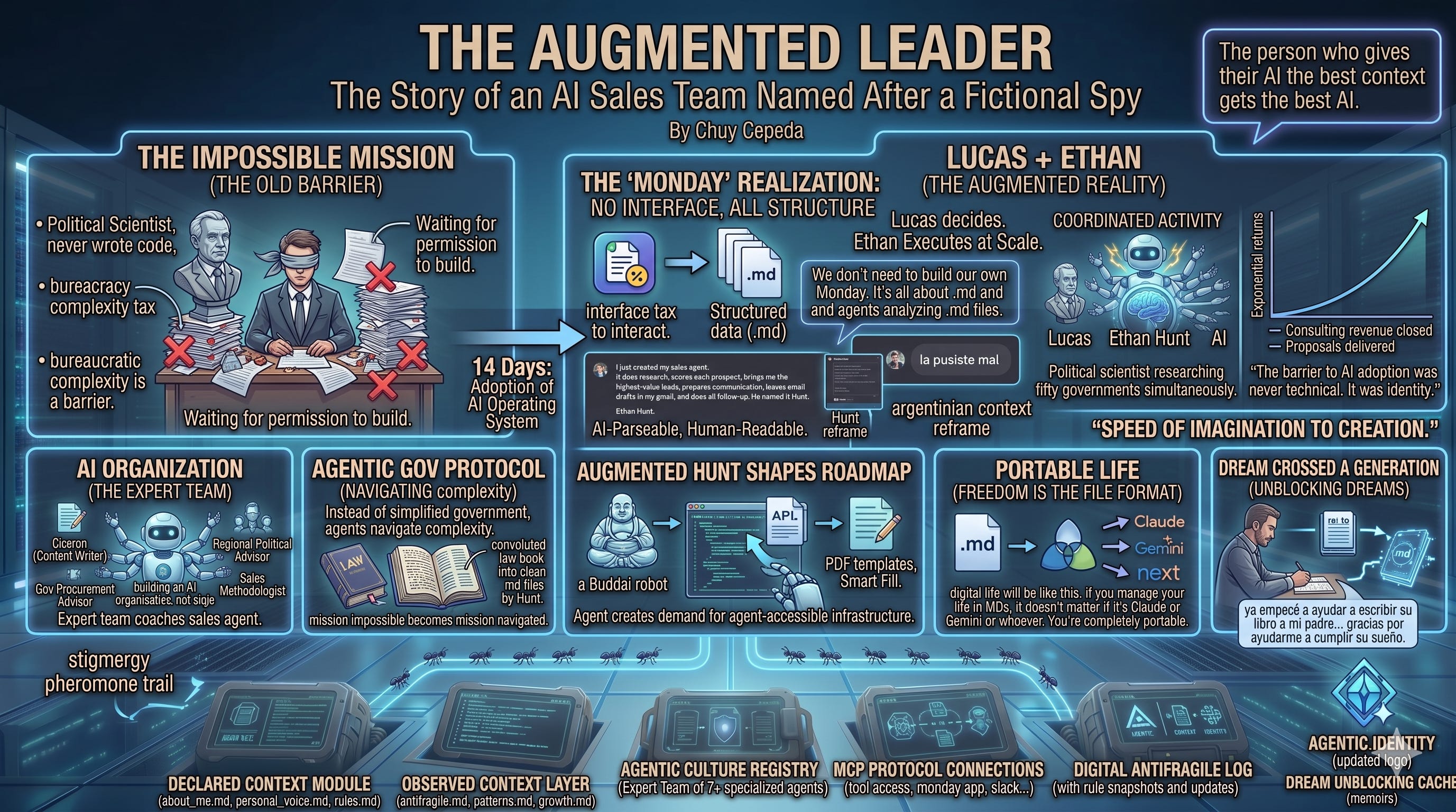
The barrier to AI adoption was never technical. It was identity. Lucas is a political scientist who has never written a line of code. Fourteen days into using the AI Operating System, he built an autonomous sales agent, a scoring engine for Latin American prospects, and a vision for agentic governance. This is the story of what happened — and what it means for everyone still waiting for permission to build.
The WhatsApp Message That Started This
Two weeks ago, Lucas sent me a message that caught my eye.
“I just created my sales agent. It does research, scores each prospect, brings me the highest-value leads, prepares communication, leaves email drafts in my Gmail, and does all follow-up.”
He named it Hunt. Ethan Hunt.
Why Ethan Hunt? Because selling digital identity infrastructure to Latin American institutions is, in his words, an impossible mission. So he built a Mission Impossible agent to do it.
Lucas is not a developer. He’s a political scientist with deep expertise in public institutions, governance, and how governments actually work from the inside. He has spent years navigating bureaucracies, understanding procurement processes, and building relationships with public sector leaders across Latin America. That is his superpower. Code has never been part of it. Although he deserves full respect for knowing the tech-savvy lingo =)
He started using the AI-OS — the personal operating system I built on Obsidian and Claude — fourteen days before that message.
What Ethan Hunt Actually Does
Let me be specific, because specificity is where the hype dies and the real signal lives.
And... it will probably also demystify the hyped concept of what an agent actually is.
Ethan Hunt is a Claude-powered agent that operates on structured markdown files. It does the following:
Research. It scans publicly available data on Latin American government digital initiatives — budgets, modernization programs, procurement portals, public statements from digital government leaders. It builds a landscape of who is doing what.
Scoring. It applies a weighted framework to rank governments by readiness, budget availability, existing digital infrastructure, and political alignment with identity modernization. Lucas designed this framework from his years of institutional knowledge. The agent executes it at scale.
Lead prioritization. From the scored list, it surfaces the highest-value targets — the governments most likely to adopt, most ready to buy, most aligned with the offerings.
Communication prep. For each high-priority lead, it drafts outreach — personalized, contextual, referencing specific initiatives and pain points. Not generic templates. Messages that reflect understanding.
Follow-up. It tracks responses, schedules next touches, and maintains the relationship pipeline — all in markdown files that Lucas can read, edit, and redirect at any time.
The second screenshot from our chat showed Ethan in action: a Claude Code terminal displaying “Mission accepted” — researching the Argentine government digital landscape, identifying high-value targets, scoring provinces, launching reconnaissance agents in parallel.
This is not a toy demo. This is working sales infrastructure built by someone who has never opened a code editor in his life.
Monday Without the Interface
After watching Ethan Hunt run for the first time, Lucas sent another message that stuck with me.
“This is a Monday without the human interface.” – referring to the Monday app.
He was looking at .md files being analyzed by agents instead of clicking through a project management UI. No boards. No drag-and-drop. No color-coded labels. Just structured text files and an AI that knows what to do with them.
And then, the insight that made me sit up:
“We don’t need to build our own Monday. It’s all about .md and agents analyzing .md files.”
This is the moment I want every executive reading this to sit with.
The project management tool of the future is not a better interface. It is no interface. It is structured data — human-readable, AI-parseable — with agents that act on it. The value of tools like Monday, Asana, Notion, and Jira was never the board view. It was the structured data underneath. The interface was just the tax you paid to interact with it. And that tax? It’s about to disappear.
When your data lives in .md files, any agent can read it. Any model can process it. You are not locked into one vendor’s UX decisions, one company’s AI roadmap, one platform’s pricing changes.
Which brings us to the biggest insight of all.
The Portable Life
After the Monday realization, Lucas went somewhere I didn’t expect.
“Digital life will be like this. If you manage your life in MDs, it doesn’t matter if it’s Claude or Gemini or whoever. You’re completely portable.”
The file format is the freedom. Not the AI model. Not the platform. Not the subscription. The .md file — a plain text file that any human can read and any machine can parse — is the universal interface between humans and AI.
This matters for a reason most people haven’t thought about yet.
Right now, every AI platform wants to be your everything. They want your data inside their system, your workflows built on their tools, your context locked in their memory. And the moment they change their pricing, their terms, or their capabilities — you’re trapped.
Markdown files don’t trap you. They’re portable. They’re readable. They’re yours. You can switch from Claude to Gemini to whatever comes next, and your structured knowledge moves with you. Your agents move with you. Your context moves with you.
This is not a technical observation. This is a philosophical one. We needed a political scientist’s eye here, not an engineer.
The people who manage their professional and intellectual life in structured, portable formats will have a permanent advantage over those who don’t. Not because of any one AI tool — but because they’ll be able to use every AI tool, forever, without starting over.
Lucas saw this in week two.
Augmented Lucas
Here’s where the story gets into territory that matters for every leader thinking about AI adoption.
After building Ethan Hunt, Lucas asked me a question: should the agent “be him” in communications? Should Ethan send emails as Ethan? Should it have its own identity, its own character, its own persona?
My answer was immediate and clear.
“For now, it’s not about replacing you with a character. It’s about augmenting YOU. We don’t want anyone to know Ethan Hunt. We want them to know Lucas Aumentado.”
Lucas, augmented.
This is where most AI discourse gets the question wrong.
The question everyone keeps asking is: “Will AI replace me?” And the answer they’re looking for is either comforting (”No, never”) or terrifying (”Yes, soon”). Both answers are wrong because the question is wrong.
The right question is: What does Lucas + Ethan look like?
It looks like a political scientist who can now research fifty governments simultaneously. A strategist who can score and prioritize leads at a scale that would take a team of ten. A relationship builder who shows up to every conversation with deeper preparation than any human could do alone.
Lucas isn’t being replaced. Lucas is being multiplied. AI is just... the Amplifier.
The critical nuance: the intent layer is still human. Lucas decides which governments to pursue. Lucas defines the scoring criteria. Lucas shapes the messaging strategy. Lucas holds the relationships. Ethan executes at scale what Lucas directs with judgment.
This is what “augmented human” actually means in practice. A political scientist with an agent named after a fictional spy, doing the work of a sales team while maintaining the relationships of a diplomat. Perfect storm.
One day, Hunt will become an official citizen, only then will he officially “be”. We are already crafting his birth certificate and driver email-sender license. Be patient.
From Sales Agent to Expert Team
What happened next is what separates someone who “tried AI” from someone who is building with it.
Lucas didn’t stop at one agent. After Ethan Hunt came Ciceron — a content agent that manages his social media and publishing pipeline. Then came specialized advisors for government procurement, digital identity technology, regional political dynamics, institutional sales methodology.
The advisors train Ethan Hunt.
Think about that for a moment.
Lucas built a sales agent. Then he built a team of expert consultants to coach the sales agent. Each expert feeds specialized knowledge into Ethan’s process — making the agent better at research, better at scoring, better at communication — without Lucas having to hold all that knowledge in his own head.
He is building an AI organization with roles, specializations, and a chain of knowledge transfer.
Here’s the part I didn’t expect: Lucas didn’t follow a template to build any of this. There was no agent system designed for what he was doing. He created each agent as a structured file and invoked them as commands — his own pattern, invented from scratch. That hack became the blueprint for the agent architecture we build on today.
Still week two.
Our tech-savvy political scientist...
The Vision That Changed the Roadmap
Lucas didn’t go for the typical “look what I automated” AI story. Lucas went for a “here’s what this made me see.” The first is a feature demo. The second changes a company.
After building Ethan Hunt and his expert team, Lucas sent a message that connected directly to our company’s deepest thesis:
“We need to build the Agentic Gov Protocol. Instead of agents that buy autonomously, agents that do government procedures autonomously.”
And then the line that made everything click:
“It’s not about simplifying government. We proved that can’t be done. It’s an impossible mission.... wait...”
And then it clicked.
We ran a GovTech company for nearly a decade trying to simplify government processes. We learned a hard truth: governments don’t simplify. Political incentives, regulatory complexity, institutional inertia — the friction is structural, not accidental. You can’t design it away.
But what if you don’t need to simplify the process? What if you just need an agent that can navigate it?
This reframe changes everything.
Instead of asking governments to change (it’s been centuries, they won’t), you give citizens an agent that handles the complexity on their behalf. Mission impossible? Here’s your Hunt. The bureaucracy stays as convoluted as it wants to be. The citizen never touches it. Their agent does. In the end, there’s nothing as repetitive as the law itself. We just need to make it an .md file. Voilà!
Now, this is where identity infrastructure becomes critical: for an agent to act on your behalf with a government, it needs to prove its identity as your “gestor,” as we call it in Latam. It needs to prove who deployed it, what permissions it holds, and that it’s acting with your authorization. The same cryptographic primitives we already build — DIDs, verifiable credentials, zero-knowledge proofs — applied to a new schema: agent identity. Issuer? Lucas. Holder? Hunt. Verifier? Government portal.
That’s bureaucratic pain at a global scale.
And it’s about to vanish.
Lucas was just building a sales agent and accidentally designed the product roadmap. He placed a brilliant idea in the wrong context. Or as I like to tell him in Argentinian: “la pusiste mal”.
Lucas, augmented. And there’s more.
Augmented Hunt
One week after Lucas built Hunt, his sales agent asked for something we hadn’t built yet: an API.
Hunt was generating prospect research, scoring leads, and drafting outreach. But when it needed to attach a branded product sheet to a proposal, it hit a wall. The Sales On-Demand tool — our internal PDF generator with 19 templates — was human-only. Click a template, fill the fields, download the PDF. No way for an agent to call it.
Hunt knew Lucas helped him with this manually. So he literally told Lucas to ask me to ask Buddai, to build an API. Buddai built it. Per-user keys. A template discovery endpoint so Hunt can pick the right product sheet for the right prospect. Smart Fill so it can inject the prospect name, the deal value, the contact — and generate a branded PDF without a human touching it.
You should know who Buddai is, but in case you don’t read this.
Hunt didn’t just automate sales. It created demand for agent-accessible infrastructure. The first agent built by a non-technical cofounder is now shaping the sales process. And sending Slack messages to Buddai asking for technical tools.
That’s what augmented really looks like. Not a tool that does what you say — a partner that shows you what to build next.
Augmentation goes in every direction.
What This Means
I’ve told you a story about my cofounder. But this post isn’t really about Lucas (although I’m saying his name a lot to make him uncomfortable). It’s about what Lucas represents.
Lucas is special because he’s smart. But in this story, he’s special because he’s a non-technical person who stopped waiting for permission to build.
The entire AI industry has been telling non-technical people to wait. Wait for the no-code tools. Wait for the natural language interfaces. Wait for someone to build the thing that makes it easy enough for you. Wait. You don’t agree? Why Claude Cowork? Why Claude Chat? These are just friction to the real deal. Read me carefully: go for the “Claude Code”, AI is so good that it will spot in a second you’re non-technical and pave the way for you.
Lucas went for it. He opened an intimidating terminal, had a 2-second aha moment understanding computers like he never understood before, then described what he wanted in natural language, and built it. In two weeks, he had a working sales infrastructure, a multi-agent architecture, a portable data strategy, and a vision for agentic governance that is now on our product roadmap. Even a partners portal web app deployed in Vercel. Do you think he knew what Vercel was?
“Am I an engineer?” is the wrong question. The right question is: “Do I know what I want to build?”
Lucas knows government. He knows institutional sales. He knows what a good lead looks like, what a procurement cycle feels like, what a digital government leader needs to hear. That domain knowledge — the knowledge that takes years to build and can’t be Googled — is the actual scarce resource. Lucas’ own context layer. The code is the easy part now.
For the non-technical executive reading this: You don’t need to learn to code. You need to learn to describe what you imagine. If you can write a brief for a human team, you can build with AI agents. The skill is the same. The leverage is different. You can even ask your preferred AI tool to do a “PRD” of the following idea, and describe what you have imagined. That’s it.
For the technical founder reading this: Your non-technical cofounder is not a liability. They’re an untapped 10x multiplier. Give them the tools. Give them the context. Get out of the way. What they build will surprise you — because they see problems you don’t. Because they aren’t trapped in engineering limiting beliefs. Lucas is completely free from all the technical impossibilities an engineer sees.
Q1, Semester 1, Year 1
After all of this — the sales agent, the expert team, the Monday insight, the portable life thesis, the Agentic Gov Protocol vision — Lucas stepped back and said:
“Q1, Semester 1, Year 1. This will be super powerful.”
He’s right. And he knows he’s right because he’s living it. Not reading about it. Not attending a conference about it. Not watching a demo. Building it. Using it. Seeing what it makes possible.
We are in the first quarter of the first semester of the first year of a new way of working. The people who start now — who build their context layer, who structure their knowledge in portable formats, who learn to direct agents with domain expertise instead of code — will compound that advantage every single day.
This isn’t about AI replacing jobs. It’s about what happens when everyone can build their own team. Their own dream.
What are you building?
How much time are you spending on your context layer?
The Dream That Crossed a Generation
I want to end with something Lucas said.
Three weeks after building Ethan Hunt, Lucas sent me another message.
“ya empecé a ayudar a escribir su libro a mi padre... gracias por ayudarme a cumplir su sueño”
His father had always wanted to write his memoirs — his career, his experiences, the stories that shaped a family. The kind of project that sits in a drawer for decades because life keeps moving and the blank page never fills itself.
People die with their palette full of colors and an empty masterpiece.
Lucas took the same system he used to build a sales team — the same context layer, the same structured files, the same AI that knows his voice — and pointed it at his father’s dream. Seed files for each chapter. Source material organized. An AI partner that interviews, drafts, refines, and never forgets a detail.
The technology that scores Latin American governments for digital identity adoption is the same technology helping a father tell the story of his life.
That’s the part the industry gets wrong. They keep measuring AI by what it automates, by “40%” productivity increases. The real measure is what it makes possible.
Not how many tasks it replaces — how many dreams it unblocks.
Your competitive advantage is no longer what you know.
But the speed at which you create what you can imagine.
This is the best time to use all your colors.
Lucas didn’t just augment himself. He augmented his father. The system crossed a generation. And the book that was always going to be “someday” is being written right now.
That’s what The Amplifier actually means.