
The AI Operating System
How Context Engineering Turned My AI Into a Strategic Partner
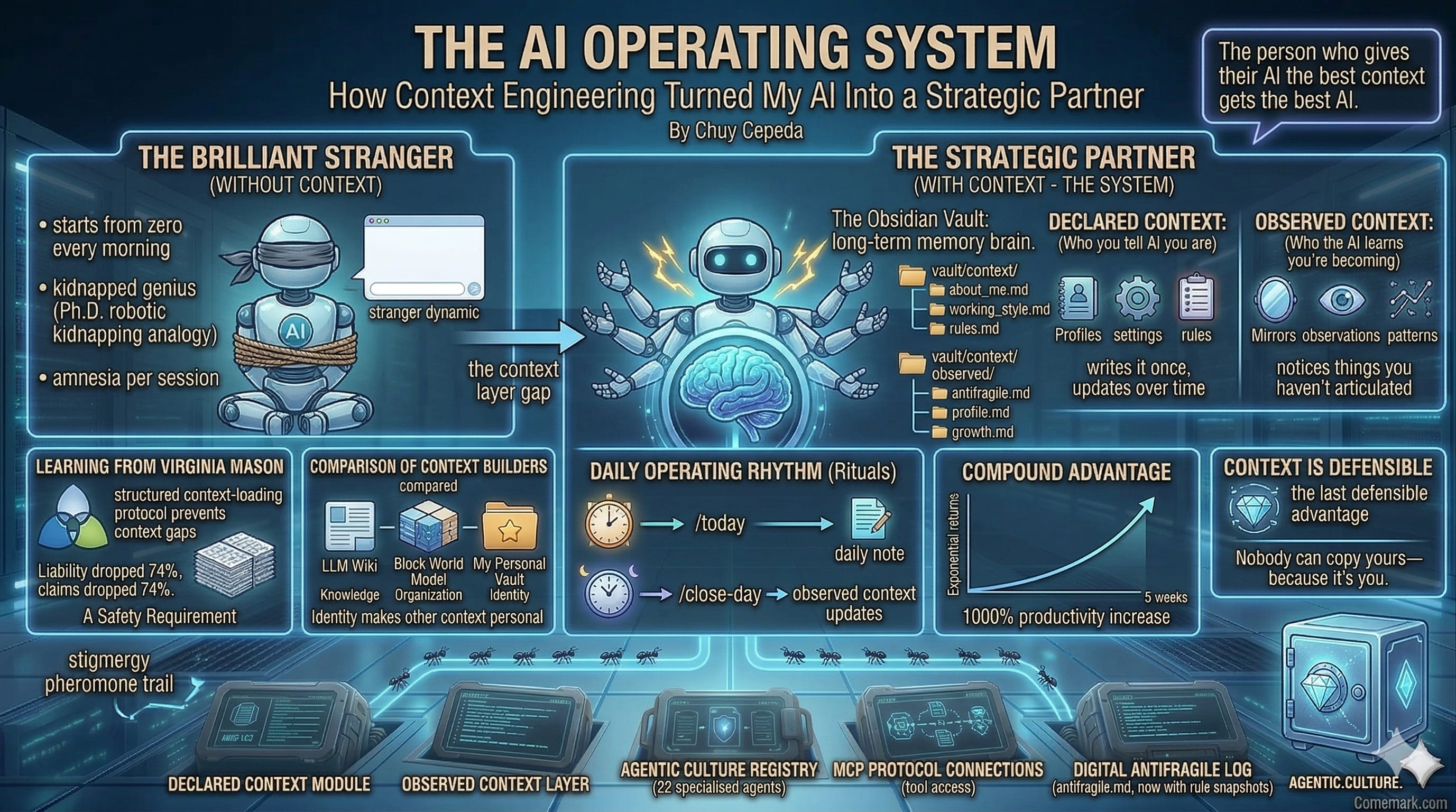
The gap isn’t AI vs. no AI. It’s AI with context vs. AI without it. One starts from zero every morning. The other compounds everything you’ve ever told it — and everything it’s learned about you.
Your AI Is a Brilliant Stranger
Every time you open ChatGPT, Claude, Gemini — whatever — you’re talking to a kidnapped genius.
When I was doing my PhD in collaborative robotics, every time my robots ran out of battery it felt like a kidnapping. They shut down in the middle of an experiment. I’d carry them back to the lab, charge them, then back to the field to keep running.
Every time this cycle repeated, the robots were confused. They had something in memory, but it was as if they’d been blindfolded, moved, and dropped somewhere familiar — with the vague sense of a brownout until they finally figured out where they were.
This is what happens to your AI every new session. You might have configured who you are in settings, but it’s not recalling other chat windows, previous sessions — anything. It was blindfolded, and it needs you to feed context again before it can start giving you the outputs you’re looking for.
And yet it’s already a genius. It has read the entire internet. It can write code, analyze markets, draft strategy memos, and explain quantum mechanics to a five-year-old. But it doesn’t know where you left off last time or how to help you now. It doesn’t know what you’re building today. It doesn’t remember that you hate bullet points in emails, that your co-founder is in Argentina, that you’ve been avoiding the sales pipeline for two weeks, or that your best thinking happens after 10 PM.
Every session starts with removing the blindfold from our genius pal. This is the default experience for 99% of AI users in 2026.
They Knew
The thing is, it’s not a bug in the technology.
It’s a gap in the architecture.
The models are extraordinary. The context engineering layer is missing. Think about it: who knows you well enough to serve you the perfect ad? Google, Meta, TikTok — they accumulated massive wealth by building the ultimate context version of you. Now you can build that same thing for yourself and feed it to your AI. Same architecture, opposite purpose. Not to serve you your best ad — but to serve you your best self.
I started building my own context layer six weeks ago. Not as a product. As my operating system — for myself, running my life, every single day, my own practice.
This post is about what I built, what it changed, and why the person who gives their AI the best context gets the best AI. It’s a guide to turning your brilliant stranger into your best strategic partner.
What Context Actually Means
Let me start with a simple analogy.
In 2001, Virginia Mason Medical Center in Seattle adopted the Toyota Production System. Not for manufacturing — for saving lives. They built a system where any staff member could stop a process when they saw a safety concern, modeled on Toyota’s andon cord — a system that lets any worker pause production when they spot a quality or safety issue. But the real breakthrough wasn’t the alert system. It was what they discovered when they investigated every incident.
70% of safety failures traced to the same root cause: context gaps.
Not skill gaps. Not equipment failures. Not inattention. Context gaps. A nurse didn’t know about a medication change from the previous shift. A doctor didn’t see a lab result that had come in overnight. A handoff lost a critical detail because the outgoing nurse mentioned it casually instead of structurally.
Virginia Mason built structured context-loading protocols for every shift change and patient handoff. The results: zero deaths from accidental harm in their patient safety categories. Liability insurance premiums dropped 74% over ten years. Malpractice claims went from the highest in their insurance group to the lowest.
The fix wasn’t training. It wasn’t better technology. It was ensuring that the incoming person started every interaction with the full context loaded — structurally, not casually.
That’s what’s missing from every AI session in 2026.
When most people use AI, the model receives one thing: the prompt. Whatever you typed in the chat box. That’s it. Best case, people fill in their settings to describe who they are — statically. But for the majority, the model has no idea who they are, what they’ve done before, what they’re trying to achieve this quarter, or how they like their sentences structured.
This is like Virginia Mason before 2001 — brilliant professionals walking into every shift with casual, incomplete context. And wondering why things go wrong.
Context is everything the AI knows about you before you ask your question, before your prompt.
There are two kinds.
Declared context is what you tell the AI about yourself — identity, voice, working style, business, psychometric profile, intent. You write it once, update it over time, and the AI reads it at every session start.
Observed context is what the AI figures out on its own — behavioral patterns, preferences, growth edges, blind spots, and what the system learns from breaking.
My AI notices things about my behavior that I hadn’t articulated to myself. It wrote them down itself. And now every future session accounts for them.
Declared context tells the AI who you are.
Observed context tells it who you’re becoming.
None of that is flattering. All of it is useful. The AI doesn’t forget that I tend to drop end-of-session steps — so it moves critical steps earlier. It doesn’t forget that abstract goals cause drift — so it frames targets as binary: shipped or not shipped. The context compounded. The AI got better at working with me. Not because the model improved. Because the context did.
Giving the Stranger a Memory
Here’s the premise:
The quality of context you give an AI entirely determines the quality of what it can do for you.
The system didn’t start as an architecture. It started as frustration. I was using Claude for real work — consulting prep, venture strategy, team comms — and every morning felt like onboarding a brilliant new hire who’d forget everything by lunch. Twenty minutes loading context that the previous session already had. Every day. The day I stopped re-explaining and started writing it down permanently — in files the AI would read before I said a word — was the day the system began.
What grew from that frustration is an Obsidian vault — a folder of structured markdown files — tracked in git, synced across machines, read by Claude at every session start. It holds two layers of knowledge: what I explicitly tell the AI, and what the AI learns by working with me over time.
Markdown files are to LLMs what that plug was to Neo when he learned Kung Fu.
Think of it as your AI’s brain. Today, your AI has memory problems — it remembers what you said in this conversation and nothing else, probably your static settings too. This system gives it long-term memory: who you are, how you work, what you’re building, what patterns it’s noticed, and what happened yesterday. And it recalls it when it needs it. Pretty much like we do before a meeting.
The result: instead of re-explaining yourself every session, you sit down and the AI is already prepared to meet you. It knows your ventures, your team, your voice, your calendar, your tradeoffs. You don’t brief the AI. The AI briefs you.
The vault essential structure:
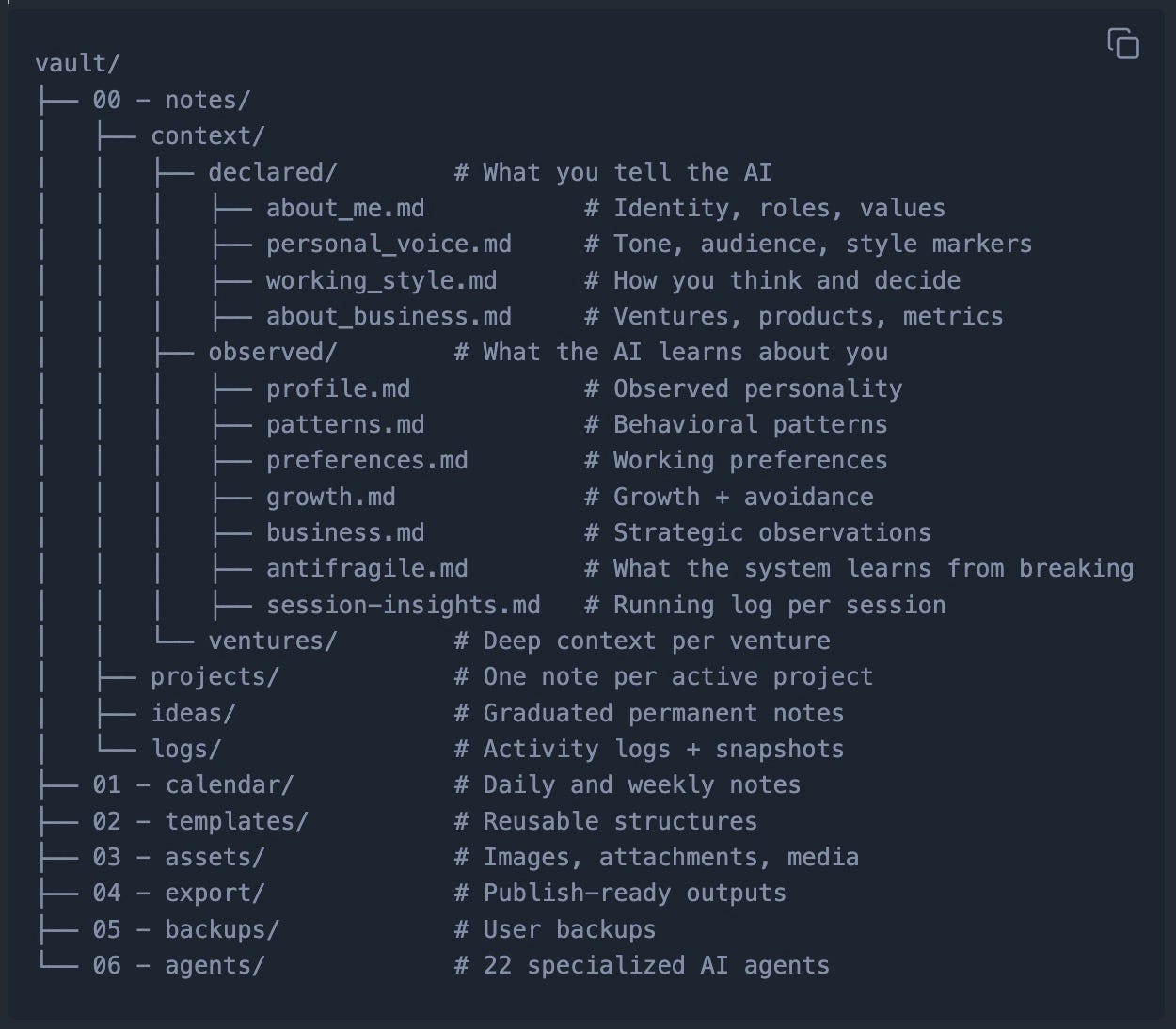
At session start, the AI reads the declared context files, then the observed context files, then any venture or project context relevant to the task. By the time you type your first message, the AI already knows who you are, what you’re building, and how you like to work.
The observed context files have strict update rules. Patterns require 2+ sessions of evidence before being recorded. Observations are distinguished from inferences. The AI is instructed to be honest, not flattering — the growth file is the most important file in the vault, and it tracks what you’re avoiding, not just what you’re achieving. Each file is structured so the AI can read a key insight, a specific section, or the whole thing — depending on what the task needs.
Everything is versioned. Before any observed context file is modified, the previous version is archived to a dated snapshot folder. Six months from now, the vault can answer: “How has this person changed?” In a couple of years, rich chapters of your autobiography are already written.
Building Discipline
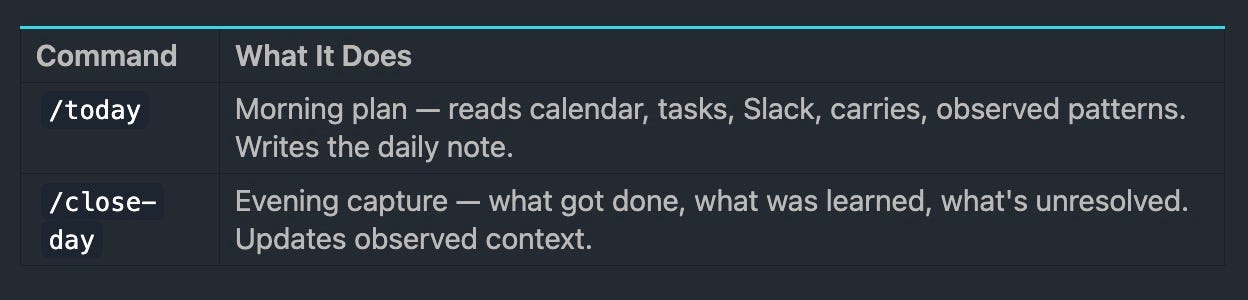
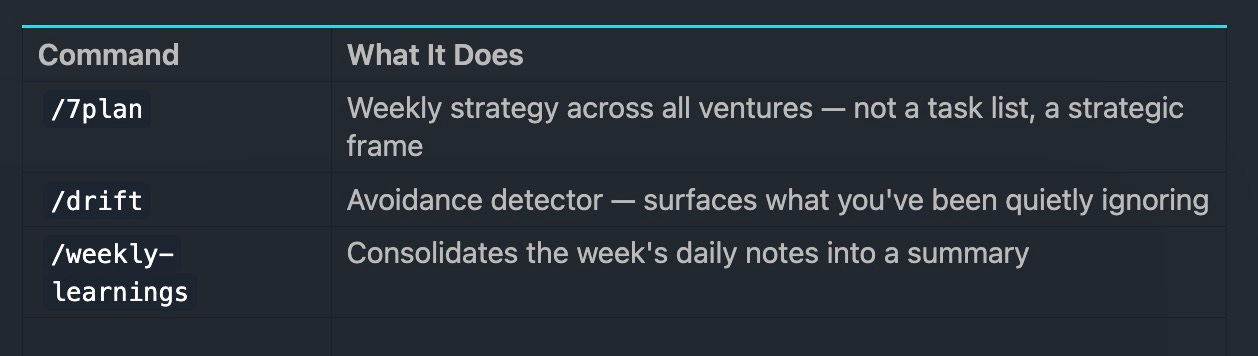
The vault runs on the stated structure and 22 custom commands, most of them inspired by InternetVin’s system — rituals, technically. Each one automates something — something that would otherwise require you to remember to do it, know the right files to read, and synthesize across multiple sources.
Here are 10 examples that run the operating rhythm:
Daily
Weekly
The mirrors — as needed
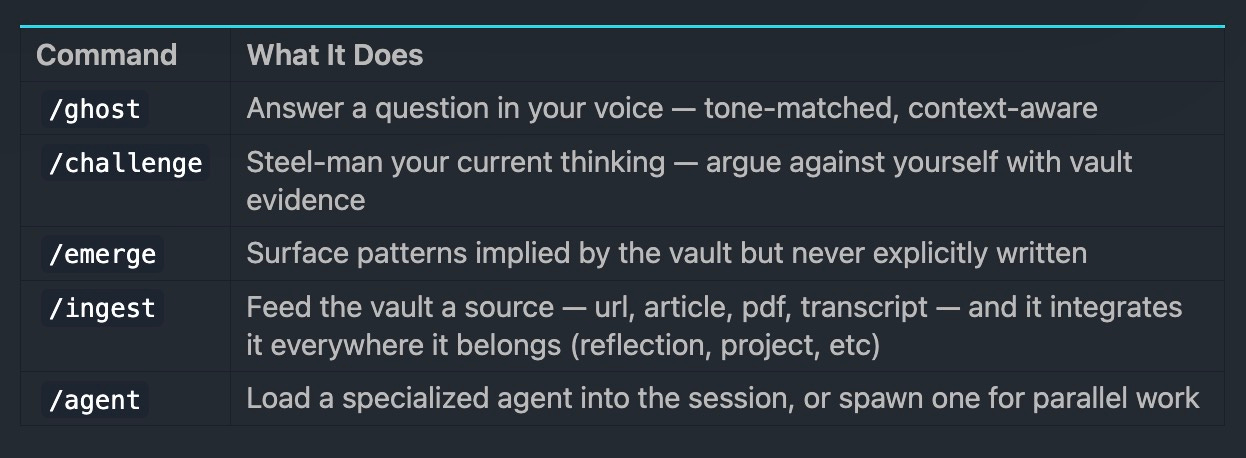
And 12 more commands that do things no human assistant would think to do — scanning the entire vault (daily notes, session insights, project to-dos, parking lots) and generating grounded ideas: things to build, things to write, things to explore, things to connect. Not brainstorming from nothing. Value that’s already latent in your own work, surfaced by an AI that has read all of it.
Processing Its Own Ideas
/ingest deserves its own section.
A few weeks ago, Andrej Karpathy published a pattern he called “LLM Wiki” — the idea that instead of retrieving from raw documents at query time, an LLM should incrementally build and maintain a persistent wiki. When you add a new source, the LLM reads it, extracts the key information, and integrates it into the existing wiki — updating entity pages, revising topic summaries, flagging where new data contradicts old claims. The tweet went viral. Everyone was sharing it.
I read it and asked my AI a simple question: “How could this idea make our system better?”
What happened next is the system demonstrating itself. The AI read Karpathy’s pattern, compared it against our existing vault architecture, and produced a structured reflection. The findings: we already did everything he described — independently. Our declared context was his “raw sources.” Our observed context was his “wiki.” Our CLAUDE.md was his “schema.” Our /backlinks, /drift, /emerge, and /connect commands were four versions of his single “lint” operation.
But he named a gap we hadn’t closed. We had no general-purpose way to process an external source — an article, a PDF, a meeting transcript, a tweet thread — and have the AI integrate it into the vault automatically. Study sessions did this for books. Venture syncs did it for business context. But there was no single command that said: “Here’s something new. Read it. Extract what matters. Update every vault file it touches.”
That’s /ingest. Feed it any source — a URL, a PDF, pasted text, a voice memo transcript. The AI reads it, discusses the takeaways with you, then files it: summary page, project note updates, context file adjustments, contradiction flags, cross-references, reflections, anything the AI thinks adds value. One article can touch dozens of vault files. The bookkeeping that would take a human an hour takes the AI two minutes — including the most intelligent next actions in your own projects, triggered by reading a single blog post.
This is what makes the vault an operating system, not just a wiki: the wiki has to land into actionable knowledge.
A wiki page that summarizes an article is useful. Landing knowledge into action is spectacular when you have dozens of projects in flight. I couldn’t have recalled every possible connection from a single read. The system can — and it does it for any amount of sources you feed it.
Then it happened again that same week. Jack Dorsey and Roelof Botha published Block’s thesis on replacing middle management with an AI “intelligence layer” — not augmenting leaders, but eliminating the coordination function entirely. I fed it to /ingest. The AI read it, mapped Block’s $50B architecture against our personal vault, and found the structural parallel: their “World Model” was our declared + observed context, again. Their “Intelligence Layer” was our agents and commands. Their “Capabilities” were our MCP tool connections. Their DRI role was our INTENT.md.
Shared thesis: context + intelligence replaces hierarchy.
The reflection the vault produced connected Dorsey’s organizational design to our agentic architecture, identified where our philosophies diverge (we keep humans governing, Block lets AI do it all), and flagged the exact chapter in my upcoming book where this story belongs. He’s going full automation, we’re going augmented leaders first, agentic culture second, then full autonomy.
What a Strategic Partner Looks Like
Here’s a short snippet of what /today produced this morning — six weeks into the system:
## Energy note
> 36 hours of forced rest. The rate limit gave you what
> GABA -14 has been asking for — a day fully present with
> your daughter on her birthday, no vault, no AI, just dad.
> Now the quota is back, mac mini crossed 300K chunks in the
> oracle while you slept, and today has 4 meetings that all
> move something forward. The machine is warm.

## Calendar
- 09:30 — Family call
- 12:00 — Accountant: tax declarations (7 days to deadline)
- 13:00 — Founders: culture document review
- 15:00 — Wallet bug verification with Alecs

## Nudge
🔍 Tax declarations at 7 days to deadline — observed
pattern: financial ops get deferred when builder energy is
high. The accountant meeting IS the action. Walk out with
a plan.

## Today I ship
→ Tax declaration plan from accountant meeting. Due Apr 17.
  No more carrying this.

## Agents can handle (just say 'go with agents')
🤖 Post review + Business class lens → spawn content-writer
🤖 Founders meeting prep → spawn meeting-prepper
🤖 Wallet bug context summary → spawn code-reviewer

## Parking lot (the radar)
🔴 MCP Setup Protocol (carried ×10) — DECIDE: start Monday
   or park explicitly
🔴 Partners Portal (carried ×10) — scheduled for Apr 21.
🔴 Review sarah's 114K words of book drafts (carried ×8) —
   light week coming. 30-min read or park until editing.
That’s 40 seconds. No re-explaining. No context-setting. No blank page.
The AI referenced my neurochemistry to explain why forced rest was what I needed — yup, days off are when I hit weekly rate limits... for now. It flagged a tax deadline because it knows I defer financial ops when I’m in builder mode. It suggested three specialized agents to spawn for today’s prep. It told me an overnight agent had processed 300,000 chunks of philosophical text while I slept. And it showed me a radar of items I’ve been carrying for over a week — not as a guilt trip, but as a decision prompt: ship, schedule, or park: DECIDE.
The rest of the day follows the same rhythm. Before my first meeting, I say: “Prep me for the call with the accountant.” The AI reads the project note, the last session notes, and my financial context. It produces the questions I need to ask and the decisions I need to make. 90 seconds.
After the team sync, I say: /ghost "Write a follow-up summarizing what we agreed." The AI writes the message in my voice — not generic professional English, but the specific tone I use with my co-founders: warm, direct, name-based greeting, no filler. It knows this because personal_voice.md defines it.
Or I just say “go with agents” — and all three tasks run in parallel while I take the next meeting.
At night, I run /close-day. The AI captures what got done, what I learned, what’s unresolved. It pulls insights and to-dos from my video call transcripts via calendar integration. It updates observed context. It asks if anything happened that’s not in the daily note. No ball is dropped. And tomorrow’s /today will start from everything that happened today.
Four interactions. No context loss. The AI remembered everything from yesterday and will remember everything tomorrow.
The Honest Part
Building this isn’t free. Vault is free. AI starts at $20. The real cost is discipline.
The initial setup takes 2-3 focused hours. Writing your declared context files. Structuring the vault. Configuring the commands. Connecting the MCPs. This is the unsexy part. It’s the part most people skip — because it feels like overhead, not output. This is where the most human work is needed and no surprising AI output happens. Vision here is key. Understanding investment and compound value are a must.
The daily discipline takes 10 minutes. Run /today in the morning. Run /close-day at night. Keep the vault updated during the day. Commit and push. It’s like journaling — except your journal talks back, and it gets smarter every week. Let your AI take every note.
The compound curve is faster than you’d expect. Here’s what mine actually looked like:
Week 1 — 10 people equivalent work. AI-OS went from idea to team-tested in 5 days. Two polished consulting proposals created in minutes. An MBA-grade financial planning system built from scratch. Four new consulting opportunities materialized through generosity, not pitching. First teammate onboarded.
Week 2 — 12 people equivalent work. A philosopher oracle with 20 resurrected thinkers built from scratch in one session — 122 corpus files, 4.3 million words indexed. 13 branded sales materials shipped in one afternoon. Three independent teams saw the system and said “we want everything.”
Week 3 — 14 people equivalent work. Consulting revenue closed with zero scheduled sales calls. Relationship → proposal → close in under 24 hours, because the AI knew my catalog, my pricing, and my voice. A 28-page whitepaper written in a single day. 10+ platform features shipped in a Friday sprint. First non-founder onboarded.
Week 4 — 10 people equivalent work. 20 specialized agents shipped. A Sales API went live and three teammates built on it independently — no assignment, no meeting. First milli deal advancing. USER.md architecture invented — one file that makes the entire system portable.
Week 5 — 29 people equivalent work. This is when overnight agents came online. While I slept, an agent wrote 42,000 words across three book manuscripts. Another synthesized 36 leadership books into 19 operational rules that now fire automatically in every session: the agentic culture was born. 1,126 corpus chunks indexed for a personal knowledge project, my personal AI boards spanning from business to spirituality. The system gained a philosophy, not just features. One person + two machines (read the fortress).
~35 people-months in the first month alone. Those numbers come from weekly reports the system itself generates from actual vault data — not estimates, not vibes. Fair disclaimer: the metric compares against average output per role — lines of code for an engineer, pages written for a content writer, proposals delivered for a sales lead. It’s directional, not scientific. But even at half the estimate, one person producing the equivalent of five is a different game.
McKinsey suggests a 40% productivity increase with AI.
Week 6, this was 1,000%. That’s context engineering and intent at play. Not better prompting.
The ratio isn’t linear — and the ceiling isn’t in sight yet.
AI is an amplifier, not a compass. The vault is the compass.
You have it all now.
For the Skeptics
If you’re thinking this isn’t for you because you’re not technical, or maybe thinking this is 1000% is for PhDs only — let me tell you this.
Our marketing lead installed the AI-OS on a Tuesday morning. By that evening — day one — she had produced:
A newsletter calendar for the next quarter
A content strategy for the coming weeks
Social posts for the week — ready to publish
A newsletter in two languages with images — ready to send
A UX testing strategy for the website
A 10x growth plan through June
A template for weekly founder briefings
In her words: “It feels like having a full content team running.”
That’s one person. One day. Zero training beyond “fill in these files about yourself.”
The vault didn’t teach her content strategy. She already knew that. What the vault did was eliminate the blank page. Every brief, every draft, every calendar started from context — her voice, her brand, her audience, her goals. AI didn’t guess. It knew.
That’s the compound effect on day one. By day 30, AI will spot which content themes are resonating, which she’s avoiding, and which ideas hiding in her daily notes deserve their own post. By day 90, the newsletter calendar will suggest itself.
But it all started with filling in three files about who she is.
Why This Matters Now
Three things converged in the last weeks:
1. Context windows got big enough. Claude’s million-token context window means the AI can read your entire vault — thousands of notes, projects, patterns — in a single session. Two years ago, you could barely fit a long email. Now you can fit a life.
2. MCP made tool access real. Model Context Protocol turned “AI that reads your Calendar, Slack, Atlassian, Monday, GitHub — all of your sources” from a demo into a daily workflow. The integrations are live, authenticated, and scoped. The AI doesn’t just know about your tools — it uses them.
3. Agentic AI made the stakes real. When AI just answered questions, bad context meant bad answers. Annoying, not dangerous. When AI acts on your behalf — sending emails, writing code, managing projects — bad context means bad actions. The quality of what the AI knows about you isn’t a nice-to-have anymore. It’s a safety requirement.
The window is open. The tools exist. The people building context systems now will have a compounding advantage that’s nearly impossible to replicate later — because the value isn’t in the system. It’s in the months of accumulated observation that live inside it.
This is why we’re seeing a second wave of “AI experts” — moving from teaching you Canva to teaching you Obsidian + Claude…
My Strategic Partner
I’ve given talks at the World Economic Forum, at TED, at Devcon. I’ve built companies, trained governments, taught executives. And after six weeks of building and living inside this system every single day, here’s what I know:
The person who gives their AI the best context gets the best AI.
Not the person with the best prompt. Not the person with the most expensive subscription. Not the person who follows the most AI influencers. The person who sat down, wrote out who they are, structured how they work, and let the AI observe them over time.
That person’s AI is a different species.
Same model. Same price. Completely different output.
You might be thinking you’re on the advantage side for using AI — prompting, chatting, getting decent outputs. But for someone else, their system is getting smarter, their agents getting sharper, their context getting deeper. You’re starting from a relative zero every session. They’re starting from intelligently engineered context. That gap doesn’t close. It widens.
That’s how big tech amassed a fortune — by building the context layer for you.
The context layer is the last defensible advantage in AI.
Models commoditize. Prompts get copied. Context compounds.
And nobody can copy yours — because it’s you.
Your turn.
Chuy Cepeda (PhD AI) is cofounder of Sovra (The Identity Stack). This post is part of an ongoing series on what happens when you stop using AI as a tool and start building it as infrastructure. If someone you know is needing this, share it with them. The AI gap is gonna be tough.